
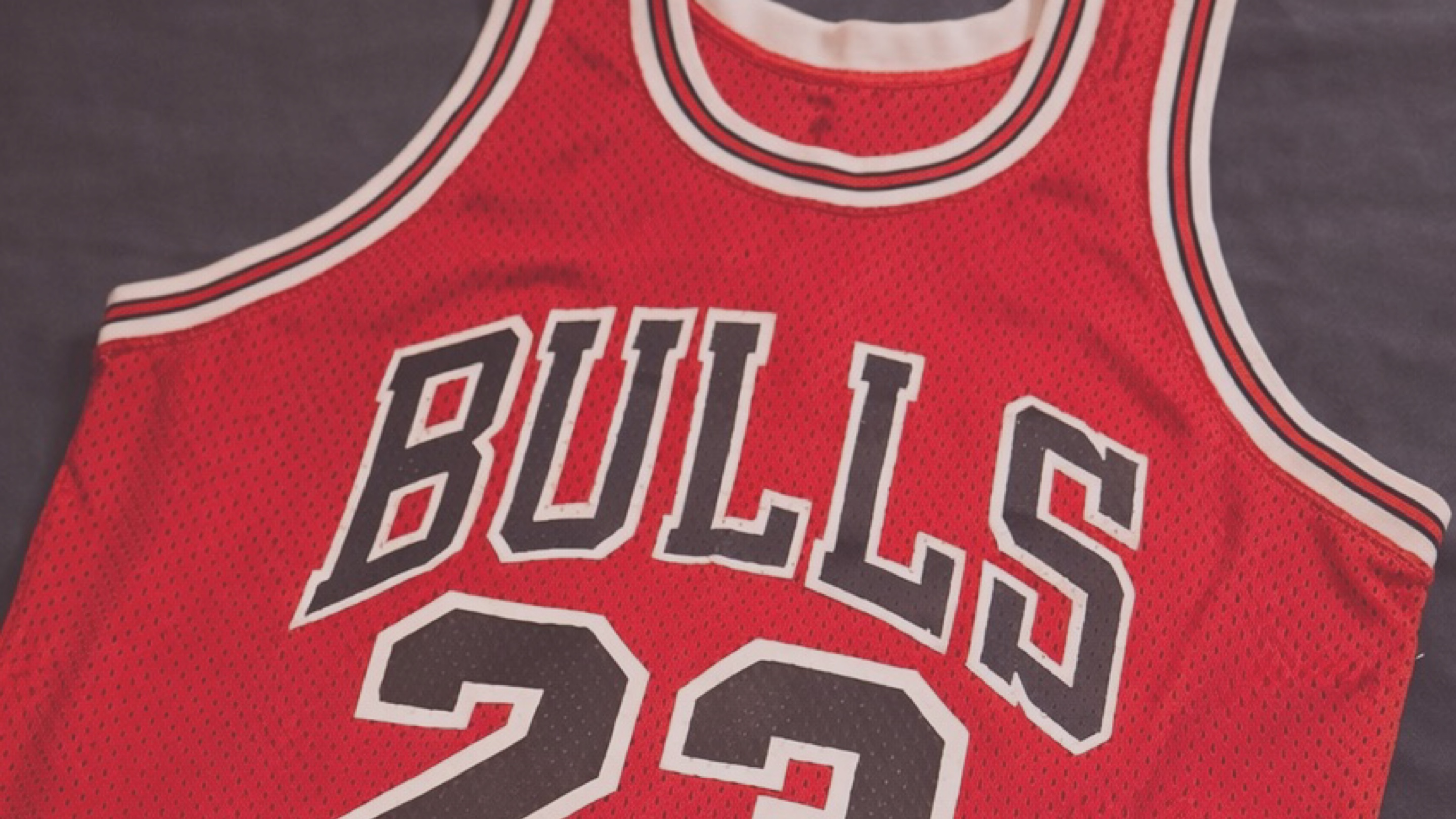
AN EARLY 1985–86 CHICAGO BULLS ROAD JERSEY
This case study examines a Chicago Bulls road jersey attributed to the 1985–86 season that recently surfaced through a private collector. The jersey had previously been matched to a game image, but closer review raised questions regarding both the image quality and the historical context of the reference photograph. Further research ultimately demonstrated that the earlier attribution could not stand and led instead to a separate promotional photograph in which the jersey could be conclusively identified.

The Illusion of an Easy Match
At first glance, the jersey appeared to correspond with a previously published photo match. The earlier attribution relied on a magazine image believed to show Michael Jordan wearing the jersey during game action. Several visual similarities were cited in support of that conclusion, including a small irregularity along the white border of the “L” in the word BULLS.
Because the artifact itself exhibits a small white irregularity in that same area, the match initially appeared plausible. Yet plausible is not the same as conclusive. The photograph used for the attribution was taken from a printed magazine reproduction, and that immediately raised a more fundamental question: was the feature being used as an identifier actually present in the photograph, or was it being introduced through the reproduction process itself?
This is one of the central risks in early uniform research. When the available evidence is limited, a match can appear convincing simply because the general style is correct and a few visual details seem to align. But unless the source image itself is reliable, the apparent certainty may be misleading.

Reexamining the Source Image
To better understand the photograph used in the earlier attribution, the original magazine containing the image was acquired and examined directly. Once the publication was reviewed in full, a broader context began to emerge.
The Michael Jordan images in the magazine all shared the same photographer, visual style, similar framing, and the appearance of a unified photographic sequence. Rather than appearing as isolated images from unrelated settings, they presented as part of the same body of work. Three additional photographs in the same publication clearly documented Jordan or the Bulls in a preseason setting against Portland, and that provided an important anchor for dating the sequence.
The photograph used in the earlier attribution originates from the Portland preseason game played October 11, during the opening of the 1986–87 campaign, following the conclusion of the 1985–86 season.
Additional contextual details reinforced that conclusion. In multiple images, Jordan’s white wristband appears scrunched in the same distinctive way, suggesting that the photographs were taken within the same session or game sequence. This mattered because it indicated that the image used in the earlier attribution belonged to the Portland preseason context rather than the game to which the jersey had originally been assigned.
Before any lettering comparison or garment analysis could be trusted, the image itself had to be placed in the correct historical setting. Once that setting changed, the earlier attribution immediately became unstable.

Establishing photographic context is an essential first step in serious photo matching research. A photograph may appear visually useful, but if its date or event is misunderstood, any attribution built upon it becomes unreliable before the garment is ever meaningfully compared.
In this instance, the surrounding images in the magazine proved just as important as the target image itself. They provided the broader context necessary to identify the sequence correctly and to test whether the earlier conclusion could withstand closer review.

Testing the Previous Attribution
With the original source in hand, the next step was to test whether the earlier comparison points could withstand closer scrutiny. They did not.
The first issue involved the small “blip” along the white border of the “L” in BULLS. That feature had been treated as a matching characteristic in the earlier attribution. However, once the photograph was viewed and captured more carefully from the printed source, the supposed feature did not appear naturally in the image. What had looked like a meaningful border irregularity was instead the result of reproduction distortion introduced through the printed magazine image.
That finding alone weakened the earlier match substantially, but the more important test came from the mesh itself. In clearer comparison images, mesh holes were visible within the red fabric fields adjacent to the lettering. Those mesh channels did not align with the artifact jersey. Because the mesh weave is fixed relative to the lettering once the jersey is manufactured, such a mismatch is highly significant.
These two findings changed the direction of the investigation. The problem was no longer simply that the earlier match seemed questionable. It was that the image used to support it was both mis-contextualized and structurally inconsistent with the artifact.


ADDITIONAL EVIDENCE FROM THE NIGHT BEFORE
The Bulls’ schedule immediately prior to the Portland preseason game provides an important point of reference. Chicago had faced the Los Angeles Lakers the night before, and clear game photography from that contest is publicly available through the Getty archive.
Both the Portland and Lakers photographs originate from the preseason immediately preceding the 1986–87 season, following the conclusion of the 1985–86 campaign. These images therefore document jerseys still in circulation from the prior season rather than newly issued garments.
Those images reveal a jersey that can be matched to multiple additional games later in the 1985–86 season. The structural characteristics visible in the Lakers photographs correspond to that documented jersey and remain consistent across those subsequent appearances.
However, those same characteristics do not match the artifact examined here. This indicates that the jersey visible in the Lakers game — and continuing into later games that season — represents a different garment from the artifact in hand.
Considering Michael Jordan’s well-documented pattern early in his career of wearing the same jersey across consecutive games rather than rotating between identical examples, the Portland photograph cannot correspond to the jersey examined in this study.


October, 1986
Inside Sports Photo-shoot
A new "BULLS" jersey design is showcased during preseason
Reopening the Search
Once the Portland image was excluded, the research moved beyond the assumption that the jersey had to resolve to a game photograph. That assumption can be limiting. Early uniform documentation frequently survives not only in game action photography, but also in editorial features, media sessions, and promotional shoots.
Expanding the evidence set in that direction proved critical. Rather than forcing the jersey into an incorrect game context, the investigation shifted toward identifying the photograph that actually documented the garment.
That shift ultimately led to a studio promotional image of Jordan wearing a Chicago Bulls road uniform. Unlike the previously cited magazine image, this photograph was clearly not live game action. It was a posed promotional shot, likely created for editorial or media use early in the season, and it provided a far stronger basis for comparison because the garment characteristics aligned structurally with the artifact in hand.
Establishing the Correct Photo Match
Comparison between the promotional photograph and the jersey revealed multiple independent identifiers. Taken together, these characteristics established the correct match.
The first strong identifier appeared within the red fabric between the numeral “2.” A vertical mesh channel could be traced through the red panel and down the central area between the numerals. The same mesh channel appeared in the identical position on the artifact jersey.
A second identifier appeared in the lower interior corner of the “L” in BULLS. In both the promotional photograph and the artifact, the black vinyl numeral in this area showed a slight triangular deformation where the vertical and horizontal strokes meet.
A third identifier involved the original border irregularity that first drew attention to the lettering. Along the white border of the “L,” the same small irregularity appeared naturally in the promotional image and aligned with the artifact jersey.

Each of these identifiers came from a different structural aspect of the jersey: mesh weave, vinyl lettering behavior, and border shape.
When multiple independent characteristics align in this way, the conclusion becomes far stronger than a match built on a single feature.


Historical Context of the Jersey
The promotional photograph that ultimately revealed the correct match can be placed very early in the 1985–86 season. Multiple pieces of evidence help establish the timing of the photo session.
Photographs from October 8 still show Michael Jordan wearing the previous Chicago Bulls road uniform featuring the cursive script lettering carried over from the prior season. In the promotional images examined in this study, however, Jordan appears in the newer block “BULLS” road jersey, indicating that the photography occurred after the transition to the updated uniform.
Additional context comes from the presence of rookie Patrick Ewing in the same promotional session. Ewing is seen wearing a sneaker colorway that had only recently been released in September, providing another marker that places the shoot at the beginning of the 1985–86 campaign.
Many of the photographs from this session later appeared in the November edition of Inside Sports, further confirming the early-season timing of the photography.

Taken together, these details indicate that the promotional photographs were produced during the weeks right before the start of the season or at the start of the season.
This timing is particularly notable within the broader history of the 1985–86 Bulls season. Just three games into the schedule — during the team’s first road trip — Jordan suffered a broken foot that would sideline him for the majority of the year. The injury occurred on October 29, 1985, in the Bulls’ third game of the season and first and only road game.
While the promotional photographs document the jersey outside of game action, the available photographic and video records indicate that the same garment was also worn at the start of the season, including the October 29 road game when the injury occurred. Jordan would not return to play until March 15, 1986.
By the time he returned late in the season, additional photographic research suggests that a different jersey had entered the team’s uniform rotation. That later garment appears to have been worn for the remainder of the 1985–86 schedule and carried forward into the following preseason.
Placed within this timeline, the jersey documented in the promotional photographs represents an artifact from the opening chapter of the 1985–86 campaign — a brief but historically significant window just before Jordan’s first major injury interrupted the season.
Why Research Standards Matter
This case illustrates why photo matching requires more than visual similarity. A photograph must first be understood in its proper historical context before it can function as evidence. If the context is wrong, any attribution built upon it becomes unreliable regardless of how plausible the comparison may initially appear.
It also demonstrates the value of using multiple independent identifiers. Surface impressions, low-resolution reproductions, and apparent similarities can be persuasive, but they are not enough on their own. Structural details such as mesh alignment, lettering deformation, and stable border irregularities provide a stronger basis for evaluation because they relate directly to how the jersey was constructed and worn.
In this case, the earlier attribution failed because the source image was misidentified and the cited comparison points did not withstand closer examination. The correct result only emerged after the photograph was dated properly, the prior assumptions were tested, and the investigation expanded to include promotional photography.
That process is the larger lesson. When the evidence is limited, the research standard must become more rigorous, not less. Careful contextual work, patient comparison, and multiple points of structural verification remain essential to documenting game-worn and player-worn artifacts accurately.
In the end, the most important result was not simply correcting an attribution, but clarifying the photographic record and demonstrating the level of care required to do this work responsibly.
In this way, the jersey serves not only as a documented artifact from the opening weeks of the 1985–86 season, but also as a case study in the standards required for reliable photo matching. Establishing the correct context of the source image, testing assumptions against the broader photographic record, and identifying multiple independent structural characteristics were all necessary steps in reaching the correct conclusion.